CELEBRATING OVER 30 YEARS OF FEE-ONLY
FINANCIAL PLANNING

INTRODUCTION
Welcome to the autumn O&A Newsletter. We begin with an article on the increasing frequency of email and phone scams, focusing on how you can avoid taking the bait. This article strives to give you simple and easy strategies with which to protect yourself, your identity credentials, and your money.
The next piece is an explanation of the new 530A (Trump) Accounts and how they work. The article offers ideas for what to do with the money, as well as other accounts that provide savings in tax-deferred or tax-exempt ways. After that, we have a report on the First National Bank of Grandpa. The Bank was discussed in a previous Newsletter but the concept continues to be of interest. Perhaps it will stimulate the thinking of others who might want to encourage younger generations to save money.
Then there is a discussion of the complicated matter of planning ahead for decisions that you and loved ones will need to make as you/they age, including housing, care, and support. A very helpful pamphlet is referenced, along with directions for how you can obtain the pamphlet. The final article discusses charitable giving and the tax-advantaged options that are available. The article includes end-of-year deadlines as well as a new benefit for taxpayers who take a standard deduction.
Office Matters includes not only what is going on in the office but book recommendations by various members of the staff. We trust you will enjoy the Newsletter.
SCAMS: DON'T FALL FOR THEM
While email, text, and phone scams are becoming more sophisticated and harder to identify, most scammers rely on many of the same tactics to lure their targets. By understanding how scammers operate and knowing what to look for, you can take steps to protect yourself and avoid becoming a victim.
Interestingly, as I (Kathy) was writing this Newsletter article, I almost fell for a scam myself. I received an email that appeared to be from my medical group offering me a “Medicare Kit” containing home first-aid items. All I had to do was complete a short survey to receive the free kit. At first, I was thrilled to receive a gift for something as harmless as a survey. However, I paused and thought “Why is it called a Medicare Kit and not a Medical Kit, (since I am not yet on Medicare), and who is this actually from?” When I looked more closely at the email address, I discovered that it had been sent from a random Gmail account that was not associated with my medical group. Even though, at that very moment I had been writing about recognizing scams, I was tempted by the promise of a free prize. Fortunately, I paused and took a deep breath, rather than acting on impulse. This experience reminded me that anyone can be targeted by a scam and that taking a moment to stop, question the offer, and verify the source can make all the difference.
Five Signs It’s a Scam
1. Scammers pretend to be from an organization you know.
They may claim to represent a charity, a government agency, or another organization that sounds legitimate. Scammers can also use technology to alter the incoming phone number displayed on your caller ID. This practice is known as “spoofing.”
2. Scammers often claim there is a prize or a problem.
They may tell you that you have won a prize, but that you must pay a fee or provide personal information to claim it. They may also tell you that you are in trouble with the government, owe money, have a loved one who needs help, or have a virus on your computer. Another common tactic is to claim there is a problem with your account and that you need to verify your personal or financial information.
3. They use fear and pressure to make you act immediately.
Scammers may use threatening or urgent language to pressure you into making a decision before you have time to think or discuss the situation with someone you trust. Their goal is to make you act before you have an opportunity to recognize the warning signs.
4. Scammers tell you to pay in a specific manner.
They may request payment through cryptocurrency, a wire transfer, an online payment app, or a gift card. Some scammers may even send you a check that appears legitimate but is actually fraudulent. After you deposit the check, they may ask you to send back any “overpayment.” By the time the bank determines that the check was fake, you may have already sent your own money to the scammer.
5. Scams often contain spelling mistakes, grammatical errors, unusual wording, or awkward sentence structure.
While a single typo does not necessarily mean the message is a scam, multiple errors or wording that seems unusual should make you stop and look more closely.
Ways to Avoid a Scam
1. Block unwanted calls and text messages.
Take advantage of the call-blocking and filtering features available on your phone and other devices.
2. If you receive a suspicious email, always check the sender's address to make sure it appears legitimate.
Deeming the sending email address as suspicious is often the first clue that the email could be a scam.
3. Do not provide personal or financial information in response to any unexpected request.
If you receive an unexpected call, text message, or email asking you to take action or provide personal information, do not respond. Hang up the phone or close the email.
4. Do not click links sent by someone claiming to represent a company or organization.
If a message asks you to verify or confirm your information, do not use the links or phone numbers provided in the message. Instead, contact the company or organization directly using a phone number or website that you know is legitimate.
5. Resist pressure to act immediately.
Take time to think and verify the information before acting.
6. Know the payment methods scammers commonly use.
Be suspicious when someone insists that you pay using cryptocurrency, gift cards, wire transfers, or other immediate payment methods.
7. Stop and talk with someone you trust.
If you are unsure whether something is a scam, discuss it with a family member, friend, or trusted person before taking action. Calling or emailing the O&A office is always an option. Remember, as I discovered, anyone can experience a moment of inattention or a lapse in judgment. Taking basic preventative measures like pausing before you act, looking for red flags, verifying information, and consulting someone you trust when something does not feel right, can help significantly reduce your risk of becoming a victim of a scam.
SAVINGS FOR KIDS - 530A ACCOUNTS
Recent news stories have announced that the government is giving away $1,000 to children in the US who meet three requirements: those receiving the money must be US citizens with a Social Security number who have been born between January 1, 2025, and December 31, 2028. The government money will be deposited into a 530A account (also known as a “Trump Account”), which was created under the One Big Beautiful Bill in 2025.
The information on these accounts has been slow to come, often confusing, and sometimes contradictory. At the time of publishing the Newsletter, it appears that a 530A account has been created for all children under the age of 18 who have a Social Security number. However, it is only those who were born in the window referenced above who are eligible for the $1,000 deposit.
The $1,000 can grow tax-deferred but cannot be withdrawn before the account owner reaches the age of 18. At that time, and going forward, the owner could
use some or all of the money for college expenses, purchase of a home, or eventually, for retirement. At this point, we advise that you open an account ONLY if you have a child who is eligible to receive the money. You can do this by filling out IRS Form 4547. We also advise that you not invest additional money in this account at the present time. There are still unanswered questions and we believe there are better ways to save for a child’s future.
529s and Roth IRAs
If your goal is to save money for education for your child (or grandchild), a 529 College Savings Plan remains a terrific choice. Withdrawals from 529 Plans that are used for education are completely tax free. A 529 Plan allows you to make significant contributions to it. In addition, beyond having no taxes due when withdrawals are made from the account, there are state tax benefits in many states for contributions to such a plan.
Money from 529 accounts can be used for K-12 education expenses, as well as most post-high-school education or training programs. If there is more money in the account than is used by the student for undergraduate or graduate education, up to $35,000 can be rolled into a Roth IRA for the beneficiary. The account can also be used by another qualified beneficiary (there is a fairly extensive list of eligible beneficiaries). As a final reminder: the 529 account remains in the control of the owner.
If your goal is to help your child look ahead to savings money for retirement, a Roth IRA is your best choice. In order to make a contribution to a Roth IRA, the child needs to have earned income and for 2026 any contribution is limited to $7,500. The long-term benefit to such an account is that money contributed today will grow tax-free for decades and then be withdrawn to benefit the child in retirement, without paying any tax.
We sometimes encourage parents and grandparents to offer a match to what a child contributes to his/her own Roth IRA as a way to increase the contribution and encourage children to start thinking about long-term saving for their future. The next article on the National Bank of Grandpa will also provide you with ideas for helping kids understand the value of saving.
In short, take the free $1,000 offered by the 530A accounts IF your child qualifies. But more important, consider a 529 plan for educational savings and a Roth IRA for retirement savings. We would be very happy to talk to you about any of these options for your child or grandchild.
GRANDPA'S BANK
More than twenty years ago, I (David) created the First National Bank of Grandpa (FNBG). Family members under the age of 22 were eligible to be depositors in FNBG savings accounts. At that point there were two possible depositors, my grandson, Carter, age 8, and his sister, Eliza, age 5. Carter had earned some money doing projects around the house and had $26. Not wanting to tie up his entire life savings, he decided to invest $20 of that in the FNBG.
I told him the Bank would initially pay interest at the rate of 10% per month. Readers of this newsletter might think that a bit excessive but I decided that if I paid him 10% per year, he would make about $.17/month, a singularly unimpressive amount. $2 a month might get his attention. If I was going to succeed in getting Carter interested in saving money and not just buying more Legos, I had to make the interest rate attractive.
Depositors in the FNBG received a bank book with columns in which I entered interest monthly, along with all future deposits and withdrawals, and a running balance. Over the first year Carter deposited another $71 and had a balance at the end of the year of $203.95. The now 9-year-old Carter was impressed with that number.
By pre-arrangement, the Bank reduced the interest rate after two years to 5% per month. This presented Carter with a greater challenge. He could figure out how much interest he would make at 10% a month but figuring out the interest for 5% tested his skills.
As the depositors aged (initially it was only Carter but soon it was also Eliza and not too long later it was their cousin, Sascha), the interest rate was gradually reduced. It stayed at 2% per month for a time, but when they were in high school, it dropped to 1% per month. Two grandchildren have now aged out of eligibility and the final grandchild has three years left. At least until now, these interest rates have not been offered to O&A clients. 😊
The FNBG has worked very well. It has gotten the grandchildren started down the road of being savers and Grandpa has not gone broke paying the exorbitant interest for 20 years. In fact, Grandpa thinks it has been a relatively inexpensive way to teach grandchildren the dramatic value of long-term savings. Carter received a final check of $17,200, having taken small amounts out along the way and a chunk to buy a car. Eliza’s final check was for about twice that. She managed to have several lucrative summer jobs which allowed her to contribute a larger amount. She also took out smaller amounts of money and made only one purchase, a violin.
In retrospect I wish I had had the foresight to build in from the start, discussions about the importance when you “grow” your savings, to also look for ways to be charitable.
We hope this gives you, the reader, ideas for encouraging personal financial literacy for your children, grandchildren, nieces and nephews, or even a favorite neighborhood child.
CHARITABLE GIVING
In our last newsletter, we wrote about the benefits and process of making charitable gifts from investment accounts. We are writing again to remind you to reach out soon if you would like our help making gifts this year.
We have offered guidance to some of you regarding gifts of appreciated investments to charity from an individual or joint account. We ask that the gift be at least $1,000 because making gifts from investment accounts is a time-consuming process. These gifts need to be processed by December 15 to make sure they get to the charities before the end of the year
Those of you who have reached the age of 70½ can make gifts from your IRA (or Inherited IRA) as Qualified Charitable Distributions (QCDs). These gifts come out of your IRA tax-free and can satisfy your Required Minimum Distribution (RMD) if you are 73 or older. The O&A staff can process gifts that are at least $1,000. These requests need to be submitted to us by December 1 to ensure that they get to the charity before the end of the year. We can also provide you with checks for your IRA so that you can send donations directly to charities. If you are using these checks provided by Schwab, we strongly recommend that the checks be sent by the end of November. The checks need to be cashed by December 31 in order to count toward your 2026 RMD. The O&A staff welcomes conversations aimed at sorting through the various tax-advantaged ways of giving money to charity.
And this is new for 2026: taxpayers who take the standard deduction on their tax return can still deduct up to $1,000 ($2,000 for married filing jointly) for gifts made to charities with cash or by check. If you take the standard deduction, be sure to let your tax preparer know if you have made any gifts to charities this year.
PLANNING AHEAD FOR YOUR LATER YEARS
We at O&A would like to urge you to read a very useful booklet called “Planning Ahead, Staying in Control of Later-Life Housing, Care, and Support Decisions,” by Dr. Kathleen Rehl. The booklet begins by acknowledging that discussions around the last stages in life are often difficult subjects to talk about. However, the author adds, “Planning ahead is not about giving up control. It is about having more choices—and more control—available when important decisions need to be made.”
She elaborates on MIT AgeLab’s everyday questions that can help us think about our quality of life as we age and our needs change. The first is Who will change my light bulbs? That sets the tone for much of this light hearted document.
The booklet compares pros and cons of different housing and care options. There is a page that looks at a host of issues and how different housing options support situations, to greater or lesser degrees, as we age. One example is widowhood, where the point is made that some housing options support being a widow more fully than others. Because there is no one perfect answer, the author hopes that families will use this practical booklet as a discussion guide. You can find the guide at https://www.kathleenrehl.com/articles/planning-ahead. We encourage readers to download and print this 12-page document. If you wish, you may call the office to request that we send you a paper version of the booklet.
OFFICE MATTERS
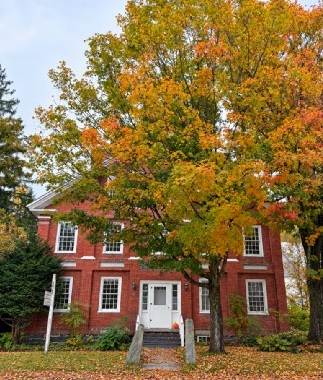 Our 16 Beaver Meadow Road red brick office building in Norwich, VT takes on an even more "settled in Vermont" look as summer has given way to fall. Susan, Laura, and Jess each enjoy their space there and David travels from Shelburne for a variety of client meetings. Both Deborah and Kathy are well adjusted to their way of staying intimately connected from their home locations in Westchester.
Susan and Jess will head to the annual Schwab conference in Boston at the end of October to represent O&A.
The entire O&A Team will gather with spouses in Katonah in November to celebrate the holidays and to continue our much-anticipated Yankee Swap tradition. Some gifts enter the mix regularly, for instance, Deborah's to die for Babkas and Rugelach from Zabar's, and Susan’s homemade jams. Others bring very creative and unusual gifts. The fun continues when there are opportunities to swap (some say "steal") gifts from colleagues.
Our staff wants you to know what they have been reading when they are not at work. What follows is a short list of some of our top choices from the past year – maybe something to enjoy on a cool autumn day or gearing up for a snowy (hopefully) winter in New England.
Sooner or Later Everything Falls Into the Sea by Sarah Pinsker – This is a collection of 13 deeply thoughtful speculative fiction short stories that weave together music, memory, technology, history, mystery, love and loss. Recommended by Laura.
My Friends by Fredrik Backman – A funny, moving tale of four teenagers whose friendship creates a bond so powerful that it changes a complete stranger’s life twenty-five years later. Recommended by Susan.
Hula by Jasmin Iolani Hakes – Set in Hawaii, a saga of tradition, culture, family, history and connection that unfolds the lives of three generations of women. Recommended by Deborah.
The Rise and Fall of the Artificial State by Jill Lapore – Just when the AI takeover feels new, strange, and inevitable, Jill Lapore shows it to be anything but that. Recommended by David.
Etna by Paul Yoon – a story told from the perspective of a former military dog who journeys across a war-torn country to find his way back home. Recommended by Kathy.
Ear Worm by Jo Knowles – Best suited for toddlers and preschoolers, this story is about a little worm who goes out to play one summer day and finds a catchy tune stuck in his head. A musical treat for the ear and eye. Recommended by Jess.